Thursday, September 24, 2009

The Shazam -- Meteor


The Shazam -- Meteor (Not Lame)

The long awaited follow up to Tomorrow The World finds The Shazam somehow pulling off the feat of sounding more classic and more weird, all on the same LP. This album is a bit more in the vein of Godspeed The Shazam, with some eccentric tunes serving as change ups for the band’s drawling take on power pop a la Cheap Trick, The Move and The Who. The difference is that there’s a bit more weirdness, some of it musical and some of it in the lyrics.

What this means is that the album is not as immediate as prior efforts, as it has an odd flow. But the hooks start to come through and the effort to provide more than cookie cutter rock lyrics is greatly appreciated.

Some of this is apparent just by looking at the titles. There is no hidden meaning behind “Latherman Shaves the World”. That’s just what the song is about. The song starts with a burst of harmony vocals shouting “Latherman,” then moving into a power jangle with Scott Ballew powering the attack with his drumming. Hans Rotenberry then works every shaving reference that he can think of into the lyrics. Whether it’s singing about things getting “hairy” or of “standing in the five o’clock shadow,” Rotenberry maintains a straight face. Meanwhile, the music isn’t jokey in the slightest. Indeed, the song moves to a spacey middle eight before really building to near anthem proportions. These guys take shaving more seriously than Gillette.

They also tell interesting stories. “NFU” is a slice of ‘70s style hard rock whimsy, about a night out that went badly because everyone but the narrator was wasted. Hans helpfully explains, “I drove -- because I was not fucked up enough.” This song bounces along like a more sped up cousin of Aerosmith’s “Last Child”, sly and clever, yet still suitable for your 8-track player.

Rotenberry’s skewed perspective further comes across on “Hey Mom I Got The Bomb”. This is The Shazam in its dixie fried Cheap Trick mode, as Hans gleefully lets everyone know that he may be “dumb and ugly and the whole world hates me,” but no one is going to pick on him anymore. The title can be taken literally. The chorus is made for shouting along at Shazam shows, the middle eight allows things to slow down before one last rocking rush, the lyrics are a gas (“going to use it with particular aplomb;” “all I ever wanted/cost me everything I had”) -- yep, this is a hell of a song.

Not everything is so silly. The band can still crank out inspiring hookfests. One of the best here is “Let It Fly”. It’s a tune that starts quietly and builds up to soaring chorus. The whole song is about just going for it and doing your best, and the music fits the encouraging lyrics perfectly. Then there’s the killer ballad, a la “Stranded Stars” from Godspeed The Shazam. Here, the killer ballad is “Don’t Look Down”. The song is a melange of sounds from The Beatles to Cheap Trick to Electric Light Orchestra to Mott The Hoople with everything leading to the mega-gigantic chorus. This track really makes me realize how Rotenberry’s vocal skills are truly underrated. He isn’t a powerhouse singer, but he has deceptive range and he is very expressive.

There are other highlights, including “Disco at the Fairgrounds”, which is on par with The Eagles Of Death Metal until the goofy chorus (and dig the ultra-high harmony vocals out of the Sweet playbook), which shouldn’t work, yet it does, and the big guitar riff fest that is “Dreamcrusher Machine”.

It’s been my view that The Shazam is the best band of the crop of great talents that spurred an indie power pop revival in the late-‘90s. This album not only solidifies that status but shows that they still have what it takes.

Thursday, September 17, 2009

Ian Hunter -- Man Overboard


Ian Hunter -- Man Overboard (New West): Hunter’s Dylanesque warble has aged quite gracefully (more gracefully than Zimmy’s voice has) and he still has stories to tell and wisdom to impart. So it’s no wonder that he continues to make worthwhile records. This isn’t a classic, but it’s full of enjoyable songs infused with Hunter’s wit and wisdom. The album starts off strong, with two really good mid-tempo rockers near the front. “The Great Escape” offers advice similar to Lynyrd Skynyrd’s “Gimme Three Steps”: that it’s important to flee “especially if the other guy is bigger than you.” This is a spirited band performance in the tradition of The Faces (as opposed to Mott The Hoople), with James (ex-Bongos) Mastro’s mandolin part really standing out. Meanwhile, “Up and Running” is in the tradition of Hunter rockers like “Just Another Night”, with a nifty piano line hook in the verses and a driving chorus that shows Hunter is still full of piss and vinegar. There are a few killer ballads, a Hunter specialty for over three decades. The best is the title track, a heartbreaking tale of an alcoholic who can’t kick his habit. The song has a brooding yet defiant vibe and Hunter’s voice is a mix of desperation and resignation tinged with the defiance of a survivor who believes that “they ain’t found a cure yet for me.” The light hearted “Girl From the Office” is a swell contrast, with Hunter lamenting that his dalliance with the hottest gal in his workplace makes him the target of everyone’s salacious questions -- “What’s she like...what’s she like in bed?” While not all of the tracks are uniformly strong, Hunter and his band tear into everything, and there are no clunkers here. I hope the Mott reunion doesn’t prevent Hunter from mounting a tour supporting this album in 2010, as this material will shine in a live setting.

Tuesday, September 8, 2009

Chris Hickey -- Razzmatazz


Chris Hickey -- Razzmatazz (Work-Fire)

Hickey’s fourth solo release is the result of a personal challenge. Hickey wrote a song every day and recorded it on a hand-held digital recorder. The 16 songs that ended up on this disc show that Hickey was up to the task.

Hickey’s music is best described as folk-pop. Generally, the basic structures of his songs adhere to folk music tenets, and that’s even more apparent on these short and sharp songs. But he has always had an ear for a strong melody, giving most of his tunes an indelible catchiness.

But what puts his music over the top are his concise and revealing lyrics and his plaintive, matter-of-fact vocals. Hickey’s range is limited, but he coaxes a lot of nuance out of his voice. Some of his songs are strictly observational, and his voice is great for conveying warmth and intelligence. When things move into more emotional territory, he can sound really vulnerable, doing so in a subtle manner. [NOTE: Since Hickey doesn't release music much, some of this is kind of a repeat of a review I wrote of his last album about six years ago or so]

Initially, this album sounds a bit fragmentary, as the songs are, understandably, pretty minimal in both the sound and arrangements. With each spin, however, more songs come into focus, and the variety of lyrical themes gives this album a distinctive character.

Two striking songs find Hickey becoming an advocate, once for a poet and once for mom-and-pop businesses. On “Keuroac”, Hickey goes Wiki, rhythmically listing details of Jack’s too short, so famous life. Each recitation of facts ends with Hickey singing, “I salute you/I am grateful.” This is affectionate and compelling.

On “Places to Go”, Hickey extols the virtues of his unnamed town, talk-singing over a bouncy strum about “shop keepers, the owners/not the greedy ones, the exploiters” but the ones who give you a place to hang out. It’s a nice sentiment, well expressed.

He also tells stories. It’s a delusional story on “Salty Tears”. Over a simple melody with minimal guitar, Hickey sings from the perspective of a guy who has found a sure thing at the track, and he explains to his wife all the great things they’ll do with the money. But Salty Tears places instead of winning, so the poor bastard rationalizes “at least it wasn’t close.”

Some songs are quite hooky, despite the spartan format. It’s hard to resist the pleasures of “Run”. The song starts with the chorus, which has a nice ebb-and-flow melody. Hickey sings with a mix of urgency and weariness, appropriate for a guy who thinks he has to bolt because “the law is banging on the door/that’s my love who’s bleeding on the floor.” The hook on “The Heat The Light” is the little melodic wrinkle which has Hickey singing near the top of his range. With the static guitar playing underneath, this quick moving up the scale is really memorable.

Another memorable track is the haunting “Nothing is Real”, a song about questioning things (“Will you still love me at 64?”, for example). Here, on the refrain, Hickey plays his guitar at a measured pace and sings accordingly, but in the verses, he moves up the scale (not being a musician, I’m not sure it’s an octave or half-octave or whatever), playing more urgently, and he sings faster to keep up. The refrain already creates tension, so to move into an even more intense part and then head back makes the tune all the more gripping.

A few songs kind of blend in, but after five spins or so, I had latched onto about half of the tracks and I’m still getting into it. Keeping things basic is no impediment for a performer who relies so much on his voice and has never been ornate. Hickey is a very special artist, who combines intellectual depth with emotional resonance and well-crafted music to accompany his lyrics. If you want something new in the folk pop vein, please check this out.

Monday, August 31, 2009

Alla -- (digs)


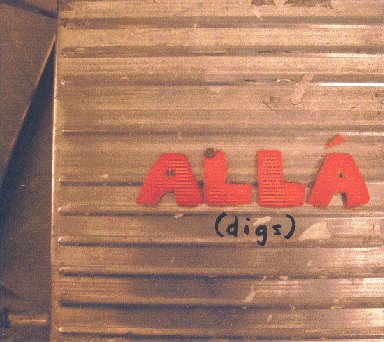
Alla -- (digs)(Crammed): Although this is a Latino trio, this Chicago band doesn’t fit the classic rock en espanol mold. This is made quite evident on this cool EP, wherein the band kicks off with an original and then goes the esoteric cover route, before finishing with a Kanye West tune. In between, they interpret The Residents, Terry Riley & John Cale, Los Dug Dugs and Faust. With the slightly raspy vocals of Lupe Martinez (who reminds me a bit of Marianne Faithful, at times) leading the way, the core band members, Jorge and Angel Ledezma do some real musical exploring. The Riley & Cale composition “Church of Anthrax” is a chance for the musicians to stretch out, with the song sounding like a cross between kraut rock and free jazz. Logically, the Faust tune, “It’s a Rainy Day, Sunshine Girl”, is just plain ol’ kraut rock and the band gives it a good work out. Martinez gets in on the action on “Smog” (a Los Dug Dugs tune), which is a concise proggy rock tune in the vein of Phil Manzanera’s 801. Her rasp is insinuating on the Velvet Underground meets Wire strum-a-thon “Si Se Puede”, the original that kicks off the album. While she intones the title phrase over and over, she sings more angelically on top. Meanwhile, she gives West’s “Love Lockdown” the soulfulness and sexiness that he could never give it with his Autotuned mechanized vocals. This EP is alternately challenging and entertaining and never boring. [NOTE: I apologize that I don't have an accent on the last 'a' of Alla and no tilde on the 'n' in 'espanol.' I tried everything on Microsoft Word and couldn't get anything to work.]

Friday, August 28, 2009

The Kingsbury Manx -- Ascenseur Ouvert!


The Kingsbury Manx -- Ascenseur Ouvert! (Odessa): The Manx are a perfect Sunday morning with a cup of coffee band. They concoct mellow, melodic creations that manage to exude warmth even though the precise arrangements could lead to a more sterile sound. If I could pull out a comparison, they stake out a sound that is somewhere between the softer pop side of Pernice Brothers and the college radio perfection of Dumptruck. Or perhaps they are the J.J. Cale(s) of the 21st Century. Regardless, this is album full of subtle pleasures that unfold with repeat plays. The characteristically gentle “If You’re on the Mend, I’m on the Move” is a sublime slice of folk-pop that has roots in Simon & Garfunkel and The Kinks. In a similar vein, “The Whip & The World” has slightly strummed guitars, crisp drumming, a pillow of keyboards and a banjo making the most friendly sounds. “Minos Maze” is something else altogether, a delicate construction that features a breathtaking harmony vocal section, something the band should explore more often. And “Well Whatever” lopes along with some nifty lead guitar ornamentation and a wistful violin in the background. With the ascendancy of groups like Fleet Foxes and Blitzen Trapper, the Manx are probably more relevant now than ever. And this album is up to their high standard.

Thursday, August 27, 2009

The Duckworth Lewis Method -- The Duckworth Lewis Method


The Duckworth Lewis Method -- The Duckworth Lewis Method (Divine Comedy):

Roger Ebert often states in his movie reviews that it’s not what a movie is about, it’s how it is about it. In other words, the subject matter isn’t as important as the treatment of the subject matter. Watching paint dry may be boring, but theoretically one could make a fascinating movie about watching paint dry.

With games that can take forever and a day, some have found cricket to be the sporting equivalent of watching paint dry. Yet The Duckworth Lewis Method have concocted a splendid album, with all of the songs centered around the sport loved throughout the British Empire, and nowhere else. How is this possible?

It starts with the talents involved. First, there is the ever-witty Neil Hannon of Divine Comedy. He is joined by Thomas Walsh, the man behind Pugwash. It is nearly impossible for these two to team up and not come up with clever and catchy pop songs. And the cleverness matters, since these guys have to dig cricket to make this album, but they also appreciate the absurdity of the enterprise. Thus, the two perform these songs in the most tongue-in-cheek manner possible.

Early on, the album simply espouses the joy of cricket for all people. On “The Age of Revolution”, Hannon and Walsh are speaking of people from all over taking up cricket: “kids in the valleys/bats bound together with string.” This call to bats rides over a looped horn part (that sounds like it’s from an old jazz record) and a mild funk-groove. It’s darned catchy.

But remember, this is an outdoor game and that comes through on the Village Green-ish “Gentlemen and Players”. Ray Davies would be proud of this paean to a Sunday spent playing cricket, and breaking for tea in an English garden. Hannon’s harpsichord (!) adds to the stately flavor, as he shows where he stands in this class war...or rather, match: “to enhance the gentry’s chances/they were granted the advantage of an extra stump/but they still couldn’t hit a barn door.”

Once the boys establish the democratic nature of their favorite sport, it’s time to get down to more arcane matters. Whether it’s the bouncy ‘70s rock vibe of “Test Match Special”, an ode to cricket matches between two countries (and only a handful can play test matches) that go on for days, or the Brit-pop perfection of “Meeting Mr. Miandad”, where they fantasize about meeting the Pakistani cricket legend (“it’s our historical phantasmagorical destiny”), they are spot on.

They are especially spot on with “Sweet Spot”. Over a cracking good glam rock drum beat, Hannon and Walsh concoct what is likely the best ever ‘cricket as a metaphor for performing oral sex on a woman’ song ever made. Or at least one of the top five: “I’m down on my knees just to please you all the time/when I hit the sweet spot I see it in your eyes.” Yes, it’s juvenile, but juvenile + cricket = fun!

These are just some of the highlights. There’s also veddy proper piano hi-jinx of “Jiggery Pokery” and appropriately pastoral “Flatten the Hay”. There’s not a googly in the bunch.

For some reason, this album has taken a beating in the British press. Yes, there are no musical breakthroughs here, but the popcraft is exceptional. Maybe they just don’t like cricket. So what. If love cricket, you should dig this. If you don’t care or can’t stand it, it is way more fun.

Friday, August 21, 2009

Wilco -- Wilco (the album)


Wilco -- Wilco (the album) (Nonesuch)

The follow up to Sky Blue Sky finds Wilco maturing into a comfortable sound, with Jeff Tweedy continuing to spin out excellent retro-‘70s FM rock and pop, played with expertise. A song here or there gives a nod to the band’s experimental bent, but more often, the muso tendency is subjugated to serve the songs.

While somewhat underwhelming on the first couple of spins, further plays reveal that Wilco has come up with a darned good album, a mix of whimsy, experimentation and heartfelt sentiments. It breaks no new ground, but has plenty of songs that are hard to shake.

One of those songs is a tune that requires careful listening to the lyrics. “I’ll Fight” is a mid-tempo acoustic driven song with a simple, passionate refrain, as Tweedy declares how he’ll go, fight, kill and die for someone. On the surface, the song sounds like a love song of extreme devotion. But listen more carefully, and you realize that Tweedy is literally fighting and killing -- he’s a soldier who is taking the place of someone else. He notes he “won’t regret the fairness of our trade....for you to live, I took your place.” This was a common practice back in the day, where someone with enough money could pay for someone else to go to war for them (President Grover Cleveland did so to avoid serving in the Civil War). This is a powerful track.

“Bull Black Nova” is equally powerful, but more direct, yet artier. This is prog Wilco, a song centering on a tense lockstep rhythm which periodically releases into some jazzy guitar riffing. The band plays with intensity and precision, building tension and releasing while Tweedy sings of a fugitive, with blood on his hands and everywhere else. The music perfectly fits the atmosphere and confusion of someone on the run. This is an instant classic.

Elsewhere, the band is more tender and playful. For a good example of the band’s playful side, just hit play and listen to “Wilco (the song)”. The song is driven by Mikael Jorgensen’s keyboards as Tweedy stretches a winsome melody over a tight and vibrant rhythm that bounces up and down. Meanwhile, Tweedy assures listeners that no matter how bad things get, that they can put on their headphones and “Wilco will love you baby.” This is a 21st Century update of Lou Reed’s “Turn to Me”.

Meanwhile, the band gets sly on what seems to be a romantic romp on “You And I”. With Leslie Feist providing supporting vocals, the acoustic music is aw-shucks ‘70s pop love. But Tweedy is effectively declaring intimacy unnecessary: “Oh, I don’t want you to know/and you don’t need to know/that much about me.” I don’t know if therapists will approve of this.

This stands in contrast to the powerful album closer, “Everlasting Everything”. Tweedy’s voice is front and center, backed by just a piano. Tweedy simply observes that everything must die or fall apart. But his love will last forever, “or nothing could mean anything at all.” The languid verses are offset by the quick rush of the chorus, which is extremely effective.

The worst that can be said about this album is that it doesn’t have any unifying musical or lyrical theme. Putting that aside, Tweedy is still writing exceptional songs and this band is by far the best vehicle to put them across. Wilco = essential.